Engineering Calculus, made clear.
Coaching for the first-year B Tech / BE Calculus course, from the mean value theorems to Gauss's divergence theorem. Learn every topic concept-first with Vipul Sir in Goregaon and Vile Parle, and revise with a free lesson for each topic.
What is engineering calculus?
The same calculus you met in Class 12, taken much further, and the maths behind almost every engineering subject that follows.
Calculus is the mathematics of change. Differentiation measures how fast something changes; integration adds up the effect of that change. Engineering calculus extends both ideas to functions of several variables, to regions in 2D and 3D, and to vector fields.
In school, calculus mostly means differentiating and integrating functions of one variable. The first-year engineering course keeps those tools and asks bigger questions:
- Why do the rules work? The mean value theorems give the proofs behind them.
- How do we approximate? Taylor and Maclaurin series turn functions into polynomials.
- What if there are several variables? Partial derivatives, maxima and minima in 2D, and multiple integrals.
- What about direction? Vector calculus describes fields and flows, leading to Green's, Stokes' and Gauss's theorems.
Where engineers use it.
Calculus is not a topic you finish in Semester I. These ideas return in mechanics, electrical engineering, signals, fluids and machine learning.
Maxima, minima and Lagrange's multipliers find the best design under a constraint, such as the largest volume for a fixed amount of material.
Taylor series are how calculators compute sin x and eˣ, and how engineers simplify complicated models near an operating point.
Double and triple integrals give the volume of a tank, the centre of gravity of a plate and moments of inertia.
Gradient, divergence and curl describe heat flow, fluid flow and electric and magnetic fields.
Green's, Stokes' and Gauss's theorems connect what happens inside a region to its boundary, and underpin Maxwell's equations.
Beta and Gamma functions evaluate integrals that come up in probability, statistics and signal processing.
Six units.
The syllabus moves from one variable to many, and from differentiation to integration and vectors. Choose a unit to jump to its topics.
Differential calculus of one variable
Mean value theorems, sequences and series, Taylor and Maclaurin series, L'Hôpital's rule.
8 topics → UNIT 2Functions of several variables
Partial derivatives, limits and continuity, Taylor's theorem, maxima, minima and Lagrange's multipliers.
6 topics → UNIT 3Vector differentiation
Gradient, directional derivative, divergence, curl and scalar potential.
3 topics → UNIT 4Improper integrals, Beta & Gamma
Improper integrals and the Beta and Gamma functions, with their properties.
4 topics → UNIT 5Multiple integrals
Double and triple integrals, change of order and of variables, areas and volumes.
8 topics → UNIT 6Vector integration
Line and surface integrals, and the theorems of Green, Stokes and Gauss.
5 topics →Every topic, one lesson at a time.
Each lesson follows the way Vipul Sir teaches in class: the idea first, then solved examples, common mistakes and practice questions with answers.
Before you start: this course assumes Class 12 differentiation and integration. If they feel rusty, revise with the Derivatives guide first.
Differential calculus of one variable
- 01Rolle's theoremRead lesson →
Statement, geometric meaning and verification problems.
- 02Lagrange's mean value theoremComing soon
The slope of a chord equals the slope of a tangent somewhere between.
- 03Cauchy's mean value theoremComing soon
The mean value theorem for two functions at once.
- 04Convergence of sequencesComing soon
When a list of numbers settles down to a limit.
- 05Convergence of seriesComing soon
Tests to decide whether an infinite sum has a finite value.
- 06Taylor's and Maclaurin's seriesComing soon
Writing functions such as eˣ, sin x and log(1 + x) as power series.
- 07L'Hôpital's ruleComing soon
Limits of the form 0/0 and ∞/∞ using derivatives.
- 08Indeterminate formsComing soon
0 · ∞, ∞ − ∞, 1^∞, 0⁰ and ∞⁰, reduced to a form L'Hôpital's rule can handle.
Functions of several variables
- 09Partial differentiationComing soon
Differentiating with respect to one variable at a time.
- 10Limits of functions of two variablesComing soon
Why the path of approach matters.
- 11Continuity of functions of two variablesComing soon
Checking continuity at a point in the plane.
- 12Taylor's theorem for two variablesComing soon
Expanding f(x, y) about a point.
- 13Maxima and minima of two variablesComing soon
Stationary points and the second-derivative test.
- 14Lagrange's method of undetermined multipliersComing soon
Maxima and minima subject to a constraint.
Vector differentiation
- 15GradientComing soon
The direction in which a scalar field increases fastest.
- 16Directional derivativeComing soon
The rate of change in any chosen direction.
- 17Divergence, curl and scalar potentialComing soon
How a vector field spreads out and rotates, and when it has a potential.
Improper integrals, Beta & Gamma functions
- 18Improper integralsComing soon
Integrals over infinite ranges, or with an integrand that blows up.
- 19Gamma functionComing soon
Definition, properties and why Γ(n + 1) = n!.
- 20Beta functionComing soon
Definition, standard forms and properties.
- 21Beta and Gamma functions togetherComing soon
The relation between them, and evaluating integrals with it.
Multiple integrals
- 22Double integralsComing soon
Integrating over a region in the plane.
- 23Change of order of integrationComing soon
Redrawing the region to make an integral easier.
- 24Change of variables: polar coordinatesComing soon
When circles make Cartesian limits painful.
- 25Area using double integralsComing soon
Areas of regions bounded by curves.
- 26Triple integralsComing soon
Integrating over a solid region.
- 27Spherical coordinatesComing soon
Triple integrals over spheres and cones.
- 28Cylindrical coordinatesComing soon
Triple integrals over cylinders and paraboloids.
- 29Volume using triple integralsComing soon
Volumes of solids bounded by surfaces.
Vector integration
- 30Line integralsComing soon
Work done by a force along a curve.
- 31Green's theoremComing soon
A line integral round a curve as a double integral inside it.
- 32Surface integralsComing soon
The flux of a vector field through a surface.
- 33Stokes' theoremComing soon
Circulation round a curve equals the flux of the curl.
- 34Gauss divergence theoremComing soon
Flux out of a closed surface equals the integral of the divergence inside.
How Vipul Sir teaches Calculus.
First-year calculus is new territory for most students. Classes build each idea step by step before moving to exam technique.
- Pictures before formulas
Graphs, regions and surfaces are drawn first, so the limits of an integral or the meaning of a theorem make sense.
- Unit-wise formula sheets
Every result you need for a unit on one sheet, with notes on when to use each.
- University-style solved questions
Worked solutions in the format examiners expect, with every step written out.
- Weekly tests and doubt support
Regular tests to track progress, and quick WhatsApp help between classes.
Is this course for you?
Classes suit anyone studying first-year engineering calculus, whatever the starting point.
- First-year B Tech / BE students starting the course
- Students preparing for class tests and the end-semester exam
- Students clearing a backlog (KT) in Calculus
- BSc students studying multivariable and vector calculus
Calculus FAQs.
What first-year students usually ask before they join.
Is engineering calculus harder than Class 12 calculus?
It is broader more than it is harder. Unit 1 builds directly on Class 12 differentiation. Units 2 to 6 are new: several variables, multiple integrals and vectors. Students whose Class 12 differentiation and integration are strong usually find it manageable with steady practice.
What should I revise before the course starts?
Standard derivatives and integrals, the chain rule, integration by substitution and by parts, and basic 3D coordinate geometry for the multiple-integral and vector units. The Derivatives guide is a good place to start.
Which topics do students usually find hardest?
Change of order of integration, Lagrange's multipliers, and the vector integral theorems of Green, Stokes and Gauss. Each one gets much easier once you can picture the region or surface involved, which is why classes start with the drawing.
Do the classes follow my college's syllabus?
The topics on this page cover the standard first-year engineering calculus course. Universities order and name the units a little differently, so bring your syllabus to the free demo and Vipul Sir will map it for you.
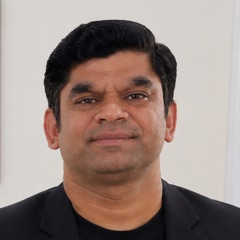
Vipul Sir has taught mathematics for over 15 years to HSC, CBSE, ICSE, IGCSE/IB, Diploma, Engineering and BSc students at VVS Classes in Goregaon and Vile Parle, Mumbai. He teaches every class himself, concepts first and exam technique second.
See how Calculus clicks with Vipul Sir.
Small batches in Goregaon and Vile Parle. Bring the unit you're stuck on to a free, no-pressure demo.