What makes a form indeterminate
Before you start: every method on this page ends with L'Hôpital's rule. Make sure you're comfortable with it first.
A limit is in an indeterminate form when substituting gives an expression whose value can't be decided from the form alone. For example, \(0 \cdot \infty\) could be anything:
- \(x \cdot \dfrac{1}{x} \to 1\)
- \(x \cdot \dfrac{1}{x^2} \to \infty\)
- \(x^2 \cdot \dfrac{1}{x} \to 0\)
All three are \(0 \cdot \infty\) as \(x \to 0^{+}\), yet the answers differ. You have to rework the expression to find out which.
\[\frac{0}{0}, \quad \frac{\infty}{\infty}, \quad 0 \cdot \infty, \quad \infty - \infty, \quad 1^{\infty}, \quad 0^{0}, \quad \infty^{0}\]
The first two are handled directly by L'Hôpital's rule. The other five are first rewritten into one of those two.
Not indeterminate: \(0^{\infty} = 0\), \(\infty^{\infty} = \infty\), \(\infty + \infty = \infty\), \(\infty \cdot \infty = \infty\), and \(\dfrac{1}{0^{+}} = +\infty\). Those have definite values.
How to reduce each form
| Form | What to do | Result |
|---|---|---|
| \(0 \cdot \infty\) | Write \(f \cdot g = \dfrac{f}{1/g}\) or \(\dfrac{g}{1/f}\). Usually, move the log or trig factor to the top. | \(\tfrac{0}{0}\) or \(\tfrac{\infty}{\infty}\) |
| \(\infty - \infty\) | Combine into a single fraction (take the LCM), or rationalise. | \(\tfrac{0}{0}\) |
| \(1^{\infty}\), \(0^{0}\), \(\infty^{0}\) | Let \(y = f(x)^{g(x)}\). Take logs: \(\log y = g(x)\,\log f(x)\). Find this limit \(L\). | \(\lim y = e^{L}\) |
If \(f(x) \to 1\) and \(g(x) \to \infty\), then \[\lim f(x)^{g(x)} = e^{\lim g(x)\,[f(x) - 1]}\]
The shortcut comes from \(\log f \approx f - 1\) when \(f\) is close to 1. It is often much faster than taking logs.
Solved examples
Eight examples, covering every form.
Example 1: 0 · ∞
EasyEvaluate \(\displaystyle\lim_{x \to 0^{+}} x\log x\).
- Form \(0 \cdot (-\infty)\). Move the log to the top: \(\dfrac{\log x}{1/x}\), which is \(\tfrac{-\infty}{\infty}\).
- L'Hôpital: \(\dfrac{1/x}{-1/x^2} = -x\).
- \(-x \to 0\).
Answer\(0\)
Example 2: ∞ − ∞ with trig
MediumEvaluate \(\displaystyle\lim_{x \to 0}\left(\frac{1}{x} - \frac{1}{\sin x}\right)\).
- Form \(\infty - \infty\). Combine: \(\dfrac{\sin x - x}{x\sin x}\), which is \(\tfrac{0}{0}\).
- L'Hôpital: \(\dfrac{\cos x - 1}{\sin x + x\cos x}\), still \(\tfrac{0}{0}\).
- Again: \(\dfrac{-\sin x}{2\cos x - x\sin x} \to \dfrac{0}{2}\).
Answer\(0\)
Example 3: ∞ − ∞ with logs
Exam levelEvaluate \(\displaystyle\lim_{x \to 1}\left(\frac{x}{x - 1} - \frac{1}{\log x}\right)\).
- Combine: \(\dfrac{x\log x - (x - 1)}{(x - 1)\log x}\), which is \(\tfrac{0}{0}\).
- L'Hôpital: numerator → \(\log x + 1 - 1 = \log x\); denominator → \(\log x + \dfrac{x - 1}{x}\). Still \(\tfrac{0}{0}\).
- Again: \(\dfrac{1/x}{\frac{1}{x} + \frac{1}{x^2}}\). At \(x = 1\): \(\dfrac{1}{1 + 1}\).
Answer\(\dfrac{1}{2}\)
Example 4: 1^∞: the number e
EasyEvaluate \(\displaystyle\lim_{x \to 0}(1 + x)^{1/x}\).
- Form \(1^{\infty}\). Let \(y = (1 + x)^{1/x}\), so \(\log y = \dfrac{\log(1 + x)}{x}\).
- This is \(\tfrac{0}{0}\); L'Hôpital gives \(\dfrac{1/(1 + x)}{1} \to 1\).
- So \(\log y \to 1\), and \(y \to e^{1}\).
Answer\(e\)
Example 5: 1^∞ with cos x
MediumEvaluate \(\displaystyle\lim_{x \to 0}(\cos x)^{1/x^2}\).
- Form \(1^{\infty}\). \(\log y = \dfrac{\log\cos x}{x^2}\), which is \(\tfrac{0}{0}\).
- L'Hôpital: \(\dfrac{-\tan x}{2x} \to -\dfrac{1}{2}\), using \(\dfrac{\tan x}{x} \to 1\).
- So \(y \to e^{-1/2}\).
Answer\(\dfrac{1}{\sqrt e}\)
Example 6: 0⁰
EasyEvaluate \(\displaystyle\lim_{x \to 0^{+}} x^{x}\).
- Form \(0^{0}\). \(\log y = x\log x\), which tends to 0 (Example 1).
- So \(y \to e^{0}\).
Answer\(1\)
Example 7: ∞⁰
EasyEvaluate \(\displaystyle\lim_{x \to \infty} x^{1/x}\).
- Form \(\infty^{0}\). \(\log y = \dfrac{\log x}{x}\), which tends to 0 (by L'Hôpital, \(\dfrac{1/x}{1} \to 0\)).
- So \(y \to e^{0}\).
Answer\(1\)
Example 8: 0⁰ with trig
Exam levelEvaluate \(\displaystyle\lim_{x \to 0^{+}} (\sin x)^{\tan x}\).
- Form \(0^{0}\). \(\log y = \tan x\,\log\sin x = \dfrac{\log\sin x}{\cot x}\), which is \(\tfrac{-\infty}{\infty}\).
- L'Hôpital: \(\dfrac{\cos x/\sin x}{-\operatorname{cosec}^2 x} = -\sin x\cos x \to 0\).
- So \(y \to e^{0}\).
Answer\(1\)
For every exponential form, write the last line as “\(\log y \to L\), so \(y \to e^{L}\)”. Forgetting to exponentiate back, and giving \(L\) as the answer, is the single most common way students lose marks here.
Common mistakes
1. Treating \(1^{\infty}\) as 1
\((1 + x)^{1/x} \to e\), not 1. The base is only approaching 1, while the power grows without bound.
2. Forgetting to exponentiate back
If \(\log y \to -\dfrac{1}{2}\), the answer is \(e^{-1/2}\), not \(-\dfrac{1}{2}\).
3. Calling definite forms indeterminate
\(0^{\infty} = 0\) and \(\infty^{\infty} = \infty\). These are not on the list of seven.
4. Splitting \(\infty - \infty\) into two separate limits
\(\lim\left(\dfrac{1}{x} - \dfrac{1}{\sin x}\right)\) is not \(\lim\dfrac{1}{x} - \lim\dfrac{1}{\sin x}\), because neither limit exists. Combine into one fraction first.
How it's asked in exams
- Evaluate a limit in one of the forms \(0\cdot\infty\), \(\infty - \infty\), \(1^{\infty}\), \(0^{0}\) or \(\infty^{0}\).
- Find constants so that a limit takes a given value.
- Combined with series: some limits are quickest using Taylor's and Maclaurin's series instead of repeated differentiation (see practice question 8).
Practice questions
Try each one on paper before you open the answer.
Q1\(\displaystyle\lim_{x \to 0} x\cot x\)
\(0 \cdot \infty\): \(x\cot x = \dfrac{x}{\sin x}\cdot\cos x \to 1 \cdot 1 = 1\).
Q2\(\displaystyle\lim_{x \to \pi/2}(\sec x - \tan x)\)
\(\infty - \infty\): \(\sec x - \tan x = \dfrac{1 - \sin x}{\cos x}\), which is \(\tfrac{0}{0}\). L'Hôpital: \(\dfrac{-\cos x}{-\sin x} \to 0\).
Q3\(\displaystyle\lim_{x \to 0}\left(\frac{1}{x} - \frac{1}{e^x - 1}\right)\)
Combine: \(\dfrac{e^x - 1 - x}{x(e^x - 1)}\). L'Hôpital: \(\dfrac{e^x - 1}{e^x - 1 + xe^x}\), still \(\tfrac{0}{0}\). Again: \(\dfrac{e^x}{2e^x + xe^x} \to \dfrac{1}{2}\).
Q4\(\displaystyle\lim_{x \to \infty}\left(1 + \frac{a}{x}\right)^{bx}\)
\(1^{\infty}\). By the shortcut: \(e^{\lim bx\cdot\frac{a}{x}} = e^{ab}\).
Q5\(\displaystyle\lim_{x \to 0}(1 + \sin x)^{\cot x}\)
\(1^{\infty}\). Shortcut: \(e^{\lim \cot x\cdot\sin x} = e^{\lim\cos x} = e^{1}\). Answer: \(e\).
Q6\(\displaystyle\lim_{x \to 1} x^{1/(1 - x)}\)
\(1^{\infty}\). \(\log y = \dfrac{\log x}{1 - x}\). L'Hôpital: \(\dfrac{1/x}{-1} \to -1\). So \(y \to e^{-1} = \dfrac{1}{e}\).
Q7\(\displaystyle\lim_{x \to 0^{+}} x^{\sin x}\)
\(0^{0}\). \(\log y = \sin x\log x = \dfrac{\log x}{\operatorname{cosec} x}\). L'Hôpital: \(\dfrac{1/x}{-\operatorname{cosec} x\cot x} = -\dfrac{\sin x}{x}\cdot\tan x \to -1\cdot 0 = 0\). So \(y \to 1\).
Q8Challenge. \(\displaystyle\lim_{x \to 0}\left(\frac{\tan x}{x}\right)^{1/x^2}\)
\(1^{\infty}\). From the series \(\tan x = x + \dfrac{x^3}{3} + \cdots\), we get \(\dfrac{\tan x}{x} - 1 = \dfrac{x^2}{3} + \cdots\)
Shortcut: \(e^{\lim \frac{1}{x^2}\cdot\frac{x^2}{3}} = e^{1/3}\).
Bring it to a free demo class and work through it with Vipul Sir. Book on WhatsApp.
Frequently asked questions
What are the seven indeterminate forms?
\(\tfrac{0}{0}\), \(\tfrac{\infty}{\infty}\), \(0\cdot\infty\), \(\infty - \infty\), \(1^{\infty}\), \(0^{0}\) and \(\infty^{0}\).
Why is 1^∞ indeterminate if 1 to any power is 1?
Because in a limit the base is only approaching 1, not equal to it. A base slightly bigger than 1, raised to a huge power, can give any value. \((1 + \tfrac{1}{n})^n \to e\) is the famous example.
Is 0^∞ an indeterminate form?
No. A base approaching 0 raised to a power growing without bound always tends to 0.
How do I handle the exponential forms?
Let \(y\) be the expression, take logs to turn it into a \(0\cdot\infty\) form, find the limit \(L\) of \(\log y\), and give the answer as \(e^{L}\). For \(1^{\infty}\), the shortcut \(e^{\lim g\,(f - 1)}\) is usually quicker.
Unit 1 complete: what comes next
← All 33 Calculus topics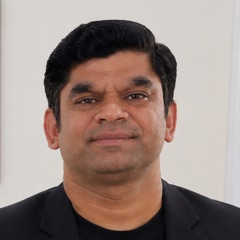
Vipul Sir has taught mathematics for over 15 years to HSC, CBSE, ICSE, IGCSE/IB, Diploma, Engineering and BSc students at VVS Classes in Goregaon and Vile Parle, Mumbai. He teaches every class himself, concepts first and exam technique second.