The theorem
Before you start: you'll need line integrals, surface integrals and curl.
If \(S\) is an open surface with boundary curve \(C\), then
\[\oint_C \vec F\cdot d\vec r = \iint_S (\nabla\times\vec F)\cdot\hat n\,dS\]
The direction round \(C\) and the normal \(\hat n\) follow the right-hand rule: curl the fingers of your right hand along \(C\), and your thumb points along \(\hat n\).
In words: the circulation round the edge equals the total swirl (curl) through any surface spanning that edge. When \(S\) is flat in the \(xy\)-plane, this is exactly Green's theorem.
Useful consequences
- Any surface with the same edge gives the same answer. To evaluate \(\iint_S(\nabla\times\vec F)\cdot\hat n\,dS\) over a curved cap, you may replace the cap with the flat disc it sits on.
- Irrotational fields have zero circulation: if \(\nabla\times\vec F = \vec 0\), then \(\oint_C \vec F\cdot d\vec r = 0\) for every closed curve.
Solved examples
Example 1: Verifying the theorem on a hemisphere
Exam levelVerify Stokes' theorem for \(\vec F = (2x - y)\,\mathbf{i} - yz^2\,\mathbf{j} - y^2z\,\mathbf{k}\) over the upper hemisphere \(x^2 + y^2 + z^2 = 1\), \(z \ge 0\).
- Line integral: the boundary is the unit circle in the \(xy\)-plane (\(z = 0\)). With \(x = \cos t\), \(y = \sin t\): \(\vec F\cdot d\vec r = (2\cos t - \sin t)(-\sin t)\,dt\).
- \(\displaystyle\int_0^{2\pi}\big(-2\sin t\cos t + \sin^2 t\big)\,dt = 0 + \pi = \pi\).
- Surface integral: \(\nabla\times\vec F = (-2yz + 2yz)\,\mathbf{i} + (0 - 0)\,\mathbf{j} + (0 + 1)\,\mathbf{k} = \mathbf{k}\).
- The flux of \(\mathbf{k}\) through the hemisphere equals its flux through the flat unit disc, which is the disc's area, \(\pi\).
AnswerBoth sides equal \(\pi\).
Example 2: Using Stokes to evaluate a circulation
MediumUse Stokes' theorem to find \(\displaystyle\oint_C \vec F\cdot d\vec r\) for \(\vec F = y\,\mathbf{i} + z\,\mathbf{j} + x\,\mathbf{k}\), where \(C\) is the circle \(x^2 + y^2 = a^2\), \(z = 0\), anticlockwise.
- \(\nabla\times\vec F = (0 - 1)\,\mathbf{i} + (0 - 1)\,\mathbf{j} + (0 - 1)\,\mathbf{k} = -\mathbf{i} - \mathbf{j} - \mathbf{k}\).
- Take \(S\) as the flat disc with \(\hat n = \mathbf{k}\): \((\nabla\times\vec F)\cdot\mathbf{k} = -1\).
Answer\(-\pi a^2\)
Example 3: A conservative field
EasyShow that \(\displaystyle\oint_C \nabla\phi\cdot d\vec r = 0\) for every closed curve \(C\).
- \(\nabla\times(\nabla\phi) = \vec 0\), so the surface integral in Stokes' theorem is 0.
Answer\(0\)
When the surface is curved but its edge is a simple circle, compute the curl, then integrate over the flat disc instead. Stokes' theorem guarantees the same answer and the algebra is far lighter.
Common mistakes
1. Orientation mismatch
The direction round \(C\) and the normal must follow the right-hand rule. Mismatching them flips the sign.
2. Using Stokes' theorem on a closed surface
A closed surface (like a whole sphere) has no edge. For closed surfaces, use the divergence theorem.
Practice questions
Q1\(\vec F = z\,\mathbf{i} + x\,\mathbf{j} + y\,\mathbf{k}\), \(C\) the unit circle in the \(xy\)-plane, anticlockwise.
\(\nabla\times\vec F = \mathbf{i} + \mathbf{j} + \mathbf{k}\). Through the flat disc: \(1\cdot\pi = \pi\).
Q2\(\vec F = -y\,\mathbf{i} + x\,\mathbf{j}\), over any surface whose edge is the unit circle (anticlockwise).
\(\nabla\times\vec F = 2\mathbf{k}\), so the answer is \(2\pi\), matching the line integral in Line integrals, Example 5.
Q3Find \(\displaystyle\oint_C \big[(2xy + z^3)\,dx + x^2\,dy + 3xz^2\,dz\big]\) round any closed curve.
The field is irrotational (it is \(\nabla(x^2y + xz^3)\)), so the answer is 0.
Bring it to a free demo class and work through it with Vipul Sir. Book on WhatsApp.
Frequently asked questions
What does Stokes' theorem say?
The circulation of a field round a closed curve equals the flux of its curl through any surface bounded by that curve.
What is the difference between Stokes' and Gauss's theorems?
Stokes' theorem links a line integral with a surface integral over an open surface. Gauss's theorem links a surface integral over a closed surface with a volume integral.
Where Stokes' theorem leads next
← All 33 Calculus topics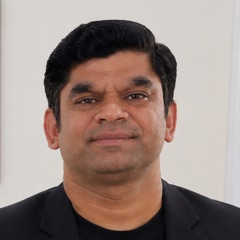
Vipul Sir has taught mathematics for over 15 years to HSC, CBSE, ICSE, IGCSE/IB, Diploma, Engineering and BSc students at VVS Classes in Goregaon and Vile Parle, Mumbai. He teaches every class himself, concepts first and exam technique second.