The formulas
Before you start: you'll need double integrals and polar coordinates.
Cartesian
\[A = \iint_R dx\,dy\]
Polar
\[A = \iint_R r\,dr\,d\theta\]
Integrating the constant 1 over a region gives its area. With vertical strips this reduces to the familiar \(\displaystyle\int_a^b (\text{upper} - \text{lower})\,dx\).
Areas of polar curves
For a curve \(r = f(\theta)\), the inner integral is always \(\displaystyle\int_0^{f(\theta)} r\,dr = \frac{f(\theta)^2}{2}\). Use symmetry to integrate over half the curve and double the result.
Solved examples
Example 1: Between a parabola and a line
EasyFind the area between \(y = x^2\) and \(y = x\).
- \(\displaystyle\int_0^1\!\!\int_{x^2}^{x} dy\,dx = \int_0^1 (x - x^2)\,dx = \frac{1}{2} - \frac{1}{3}\).
Answer\(\dfrac{1}{6}\)
Example 2: Two parabolas
MediumFind the area between the parabolas \(y^2 = 4ax\) and \(x^2 = 4ay\).
- They meet at \((0, 0)\) and \((4a, 4a)\). For \(0 \le x \le 4a\), \(y\) runs from \(\dfrac{x^2}{4a}\) up to \(2\sqrt{ax}\).
- \(\displaystyle\int_0^{4a}\left(2\sqrt a\,x^{1/2} - \frac{x^2}{4a}\right)dx = \frac{4\sqrt a}{3}(4a)^{3/2} - \frac{(4a)^3}{12a} = \frac{32a^2}{3} - \frac{16a^2}{3}\).
Answer\(\dfrac{16a^2}{3}\)
Example 3: An ellipse
MediumFind the area of the ellipse \(\dfrac{x^2}{a^2} + \dfrac{y^2}{b^2} = 1\).
- By symmetry, 4 times the first-quadrant part: \(\displaystyle 4\int_0^a\!\!\int_0^{\frac{b}{a}\sqrt{a^2 - x^2}} dy\,dx = \frac{4b}{a}\int_0^a\sqrt{a^2 - x^2}\,dx\).
- \(\displaystyle\int_0^a\sqrt{a^2 - x^2}\,dx = \frac{\pi a^2}{4}\) (a quarter circle).
Answer\(\pi ab\)
Example 4: A cardioid
Exam levelFind the area of the cardioid \(r = a(1 + \cos\theta)\).
- Symmetric about the initial line: \(\displaystyle A = 2\int_0^\pi\!\!\int_0^{a(1 + \cos\theta)} r\,dr\,d\theta = \int_0^\pi a^2(1 + \cos\theta)^2\,d\theta\).
- \(\displaystyle a^2\int_0^\pi\big(1 + 2\cos\theta + \cos^2\theta\big)\,d\theta = a^2\left(\pi + 0 + \frac{\pi}{2}\right)\).
Answer\(\dfrac{3\pi a^2}{2}\)
Example 5: One loop of a rose
Exam levelFind the area of one loop of \(r = a\sin 2\theta\).
- One loop is traced for \(0 \le \theta \le \tfrac{\pi}{2}\).
- \(\displaystyle\int_0^{\pi/2}\frac{a^2\sin^2 2\theta}{2}\,d\theta = \frac{a^2}{2}\cdot\frac{\pi}{4}\).
Answer\(\dfrac{\pi a^2}{8}\)
For polar curves, find the range of \(\theta\) that traces the curve (or one loop) exactly once. Set \(r = 0\) to find where a loop starts and ends.
Common mistakes
1. Forgetting \(r\) in polar area
Area is \(\iint r\,dr\,d\theta\), so the inner integral gives \(\dfrac{r^2}{2}\), not \(r\).
2. Tracing a curve twice
\(r = a\sin 2\theta\) has four loops over \(0 \le \theta \le 2\pi\). Integrating over the full range without thinking can double-count.
3. Upper and lower curves swapped
A negative area means the curves are the wrong way round.
Practice questions
Q1Area between \(y = x\) and \(y = x^3\) in the first quadrant.
\(\displaystyle\int_0^1(x - x^3)\,dx = \frac{1}{4}\).
Q2Area between \(y^2 = x\) and \(y = x\).
Horizontal strips: \(\displaystyle\int_0^1 (y - y^2)\,dy = \frac{1}{6}\).
Q3Area inside \(r = 2a\cos\theta\) and outside \(r = a\).
The circles meet at \(\theta = \pm\tfrac{\pi}{3}\). \(\displaystyle 2\int_0^{\pi/3}\!\!\int_a^{2a\cos\theta} r\,dr\,d\theta = a^2\left(\frac{\pi}{3} + \frac{\sqrt 3}{2}\right)\).
Q4Total area of the lemniscate \(r^2 = a^2\cos 2\theta\).
Four symmetric quarter-loops: \(\displaystyle 4\int_0^{\pi/4}\frac{a^2\cos 2\theta}{2}\,d\theta = a^2\).
Bring it to a free demo class and work through it with Vipul Sir. Book on WhatsApp.
Frequently asked questions
How do you find area using a double integral?
Integrate the constant 1 over the region: \(\iint_R dx\,dy\), or \(\iint_R r\,dr\,d\theta\) in polar coordinates.
Cartesian or polar?
Polar for curves given as \(r = f(\theta)\) or circular regions; Cartesian for regions bounded by graphs \(y = f(x)\).
Where this leads next
← All 33 Calculus topics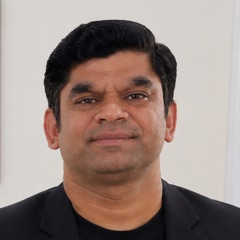
Vipul Sir has taught mathematics for over 15 years to HSC, CBSE, ICSE, IGCSE/IB, Diploma, Engineering and BSc students at VVS Classes in Goregaon and Vile Parle, Mumbai. He teaches every class himself, concepts first and exam technique second.