The formulas
Before you start: you'll need triple integrals, and often spherical or cylindrical coordinates.
\[\text{Volume} = \iiint_V dx\,dy\,dz = \iint_R \big(z_{\text{top}} - z_{\text{bottom}}\big)\,dx\,dy\]
where \(R\) is the shadow of the solid on the \(xy\)-plane.
| Solid | Best coordinates | Volume |
|---|---|---|
| Tetrahedron \(\tfrac{x}{a} + \tfrac{y}{b} + \tfrac{z}{c} \le 1\) (first octant) | Cartesian | \(\dfrac{abc}{6}\) |
| Sphere of radius \(a\) | spherical | \(\dfrac{4}{3}\pi a^3\) |
| Ellipsoid \(\tfrac{x^2}{a^2} + \tfrac{y^2}{b^2} + \tfrac{z^2}{c^2} \le 1\) | scaled spherical | \(\dfrac{4}{3}\pi abc\) |
| Cone of radius \(a\), height \(h\) | cylindrical | \(\dfrac{1}{3}\pi a^2 h\) |
Solved examples
Example 1: A tetrahedron
EasyFind the volume of the tetrahedron bounded by the coordinate planes and \(\dfrac{x}{a} + \dfrac{y}{b} + \dfrac{z}{c} = 1\).
- \(z\) runs from 0 to \(c\left(1 - \tfrac{x}{a} - \tfrac{y}{b}\right)\) over the triangle \(\tfrac{x}{a} + \tfrac{y}{b} \le 1\).
- Substituting \(x = au\), \(y = bv\) turns it into \(abc\) times the unit tetrahedron of Example 2 in Triple integrals, which has volume \(\tfrac{1}{6}\).
Answer\(\dfrac{abc}{6}\)
Example 2: Cylinder cut by a slanted plane
MediumFind the volume bounded by the cylinder \(x^2 + y^2 = 4\) and the planes \(z = 0\) and \(y + z = 4\).
- Top \(z = 4 - y\), bottom \(z = 0\), over the disc \(x^2 + y^2 \le 4\).
- \(\displaystyle\iint_{\text{disc}}(4 - y)\,dA = 4\cdot(4\pi) - \iint y\,dA = 16\pi - 0\) (the \(y\)-integral vanishes by symmetry).
Answer\(16\pi\)
Example 3: Between two paraboloids
MediumFind the volume between \(z = x^2 + y^2\) and \(z = 8 - x^2 - y^2\).
- They meet where \(r^2 = 8 - r^2\), so \(r = 2\). Height \(= 8 - 2r^2\).
- \(\displaystyle 2\pi\int_0^2 (8 - 2r^2)\,r\,dr = 2\pi(16 - 8)\).
Answer\(16\pi\)
Example 4: Two crossing cylinders
Exam levelFind the volume common to the cylinders \(x^2 + y^2 = a^2\) and \(x^2 + z^2 = a^2\).
- By symmetry, 8 times the first-octant part. There, \(z\) runs from 0 to \(\sqrt{a^2 - x^2}\) over the quarter disc \(0 \le y \le \sqrt{a^2 - x^2}\).
- \(\displaystyle 8\int_0^a\!\!\int_0^{\sqrt{a^2 - x^2}}\sqrt{a^2 - x^2}\,dy\,dx = 8\int_0^a (a^2 - x^2)\,dx = 8\cdot\frac{2a^3}{3}\).
Answer\(\dfrac{16a^3}{3}\)
Most volume questions are really “height times area”: find the top and bottom surfaces, subtract, and integrate over the shadow region. Choose polar form whenever that shadow is a disc.
Common mistakes
1. Wrong shadow region
The region \(R\) is where the top and bottom surfaces meet, projected onto the \(xy\)-plane. Find it by setting them equal.
2. Missing a symmetry factor
If you compute one octant, remember to multiply by 8 (or 4, or 2) at the end.
Practice questions
Q1Volume of the tetrahedron \(x + y + z \le 1\) in the first octant.
\(\dfrac{1}{6}\).
Q2Volume under \(z = xy\) over the rectangle \(0 \le x \le 1\), \(0 \le y \le 2\).
\(\displaystyle\int_0^1\!\!\int_0^2 xy\,dy\,dx = \frac{1}{2}\cdot 2 = 1\).
Q3Volume of a cone of radius \(a\) and height \(h\).
\(\displaystyle\int_0^{2\pi}\!\!\int_0^a\left(h - \frac{h}{a}r\right)r\,dr\,d\theta = \frac{\pi a^2h}{3}\).
Q4Volume inside the sphere \(x^2 + y^2 + z^2 = a^2\) and the cylinder \(x^2 + y^2 = b^2\) (\(b < a\)).
\(\displaystyle 2\int_0^{2\pi}\!\!\int_0^b\sqrt{a^2 - r^2}\,r\,dr\,d\theta = \frac{4\pi}{3}\Big(a^3 - (a^2 - b^2)^{3/2}\Big)\).
Bring it to a free demo class and work through it with Vipul Sir. Book on WhatsApp.
Frequently asked questions
How do you find volume using a triple integral?
Integrate 1 over the solid: \(\iiint_V dV\). Equivalently, integrate (top − bottom) over the shadow region in the \(xy\)-plane.
Which coordinates should I use?
Cartesian for boxes and tetrahedra, cylindrical for cylinders, cones and paraboloids, spherical for spheres.
Unit 5 complete: what comes next
← All 33 Calculus topics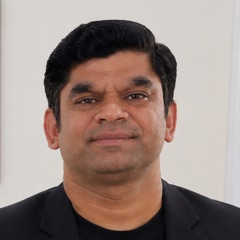
Vipul Sir has taught mathematics for over 15 years to HSC, CBSE, ICSE, IGCSE/IB, Diploma, Engineering and BSc students at VVS Classes in Goregaon and Vile Parle, Mumbai. He teaches every class himself, concepts first and exam technique second.